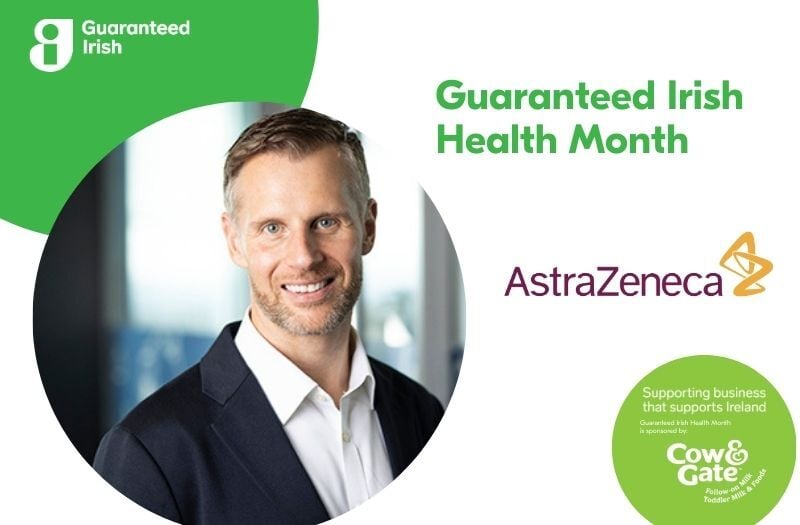
Alex Wilkes is Country President of AstraZeneca Ireland and a board member of Guaranteed Irish. With extensive international leadership experience across the pharmaceutical sector, he brings a strong perspective on innovation, skills, and sustainable growth, and is committed to strengthening Ireland’s life sciences ecosystem and patient outcomes.
Why is it important for the Board of GuaranteedIrish to include representation from the pharmaceutical sector?
Ireland’s pharmaceutical sector is a cornerstone of the economy and a major employer, and its inclusion ensures Guaranteed Irish reflects the full breadth of industries driving national growth. Pharma representation helps deepen understanding of how medicines are discovered, manufactured, reimbursed, and ultimately accessed by patients in Ireland. This insight supports focused advocacy around investment, talent, infrastructure, and timely access to innovative treatments.
The sector is also a key driver of exports and capital investment, reinforcing Ireland’s position as a leading global life sciences location. A strong pharma voice contributes to cross-sector competitiveness by informing practical policy discussions on tax, R&D supports, and critical infrastructure needs such as energy, housing, and transport, all of which influence long-term investment decisions.
Importantly, alignment on skills requirements — from chemistry and engineering to data science, AI, and regulatory expertise — helps guide partnerships with education and training providers. Including pharma on the Board ensures Guaranteed Irish represents a cornerstone industry within a diverse membership, supporting a coherent national strategy, economic resilience, and equitable access to innovative treatments for patients in Ireland.
How has your career journey led you to become involved with Guaranteed Irish?
Previously I have held board membership role in two companies in the UK and worked across several roles in various countries for multiple companies. With my role of Company President of AZ Ireland I feltI was in a strong position to bring insights both from my industry and from the120 people that work for our business in Ireland to share a valuable perspective on the board of GI.
Can you share examples of how AstraZeneca’s work in Ireland benefits the wider community?
AstraZeneca Ireland, alongside Alexion, AstraZeneca Rare Disease, employs over 1,400 people across Athlone and Blanchardstown, supporting high-quality STEM jobs and long-term growth in Ireland. We also work closely with local suppliers and practise responsible procurement, helping to strengthen indigenous businesses.
We are deeply committed to skills and education, supporting internships, industry–academia partnerships, and initiatives to develop future-ready talent, particularly in the context of recognised gaps in STEM teaching and advanced technical skills. Sustainability is another key focus, with efforts centred on energy efficiency, decarbonisation, and responsible operations at our Irish sites.
Community engagement is also central to our work. Initiatives such as employee volunteering at the TU GLAS Garden, in collaboration with Global Action Plan, demonstrate practical support for local communities while advancing our sustainability commitments. In addition, we advocate for patients in Ireland by partnering with patient advocacy groups on disease awareness campaigns and by working with policymakers to improve consistency of access to innovative treatments, helping to drive better health outcomes.
Guaranteed Irish recently published its Pharmaceutical & Life Sciences paper. From your perspective, why is it important that the pharmaceutical sector has a clear, collective voice through organisations like Guaranteed Irish?
A clear, collective voice helps align priorities across a complex ecosystem that includes manufacturing, R&D, genomics, healthcare delivery, skills development, market access, and clinical trials. Through organisations like Guaranteed Irish, industry engagement with policymakers becomes more coherent, practical, and solutions-focused.
It strengthens advocacy for timely and equitable access to medicines, supporting improved reimbursement pathways and better health outcomes. It also focuses attention on key competitiveness drivers such as policy stability, tax and R&D incentives, and enabling infrastructure — including energy, housing, and transport — that influence Ireland’s attractiveness as a life sciences hub.
Finally, a collective approach supports coordinated action on talent, helping education and training providers align programmes in science, data, AI, digital health, engineering, and regulatory affairs with industry needs. This reduces fragmentation, supports a coherent national strategy, and contributes to long-term economic resilience and better outcomes for patients in Ireland.
Supporting Business that supports Ireland